PMS Mood Swings: You're Not “Being Dramatic” — It's Hormones
You cried at a yogurt commercial. You wanted to fight a stranger for walking too slowly. Twenty minutes later you were fine, and then you were furious that anyone dared suggest you were "a little off today." If this is you roughly one week out of every four, congratulations: you are not a supervillain, a bad partner, or a walking red flag. You have PMS mood swings, and they are a pattern — not a personality flaw.
Here's the thing nobody says clearly enough: the emotional weather that rolls in before your period is a real, physiological, well-documented thing. It has a timeline. It has a cause. It shows up on a calendar with the reliability of a moon phase, because — plot twist — it basically is one. You are not "being dramatic." You are being hormonal, which is a different sentence entirely, and one you're allowed to say out loud.
Let's get into what's actually happening, why it's not a moral failing, when it might be worth a chat with your doctor, and the small, unglamorous things that many women find genuinely help.
First: it's a pattern, not a personality
The single most validating thing you can do for yourself is track your cycle for a couple of months. Not in an intense, spreadsheet-with-color-coding way (unless that's your love language, in which case, go off). Just note the days you feel emotionally sandpapered.
What most people discover is almost annoyingly consistent: the mood dip tends to arrive in the week or so before your period — the luteal phase — and then lifts once your period actually starts. That predictability is the whole point. A personality flaw doesn't clock in on schedule and clock out three days later. A hormonal pattern does.
When you can look at a calendar and go "ah, right, it's that week," two things happen. First, you stop pathologizing yourself. Second, you can actually plan around it instead of getting blindsided every single month like it's a surprise party you never RSVP'd to.
The things that are NOT the problem
- You, as a person. Your baseline personality did not develop a bug.
- Being "too sensitive." Your nervous system is temporarily running on different settings, not a worse version of you.
- Not having enough willpower. You cannot willpower your way out of a hormone shift, the same way you can't willpower your way out of being tired. That's not how bodies work.
The hormonal why (a.k.a. the group chat happening in your brain)
Okay, real talk about mechanisms, minus the biology-textbook energy. Across your cycle, two main hormones — estrogen and progesterone — rise and fall like a dramatic duet. In the second half of your cycle, after ovulation, both of them shift, and estrogen in particular takes a notable dip before your period.
Why do you care? Because estrogen is chummy with serotonin, one of the brain chemicals tied to mood and that general sense of "I am a functioning human who likes things." When estrogen drops, serotonin activity can shift too. Many women notice this lines up neatly with feeling more irritable, teary, anxious, or flat. Not because they're weak — because the chemistry backing their good mood briefly changed the vibe.
Progesterone gets in on it too. It rises in the luteal phase and has effects on the brain that can leave some people feeling calmer and others feeling more on-edge or restless — bodies are individual little snowflakes about this. And then there's the plot device nobody warns you about:
The blood sugar subplot
Your appetite and how your body handles blood sugar can shift in the luteal phase, which is partly why the cravings arrive like uninvited guests. Here's the sneaky part: blood sugar crashes feel emotionally identical to a bad mood. That 4pm "I hate everyone and everything" wave? Sometimes it's genuinely hormones. Sometimes it's that you ran on an iced coffee and vibes until mid-afternoon and your blood sugar just faceplanted. Often it's both, holding hands, walking into your day.
This matters because it's one of the few levers you have real control over — more on that in a minute.
Also invited to the party: sleep and stress
PMS can mess with your sleep, and bad sleep makes every emotion louder and less manageable — that's true for everyone, cycle or no cycle. Stack that on top of an existing hormonal dip, add a stressful week, and you've got a genuinely reasonable explanation for why you're crying in a parking lot. It's not fragility. It's math.
PMS vs PMDD: when it's more than a rough week
Here's where we get gentle and serious for a second, because it matters.
For most people, PMS mood swings are unpleasant but manageable — annoying, disruptive to a couple of days, but you're still fundamentally you. There's a more intense version called PMDD (premenstrual dysphoric disorder), where the emotional symptoms in the luteal phase are severe — think significant depression, anxiety, hopelessness, or anger that genuinely interferes with your relationships, work, or ability to function, and then lifts after your period starts.
We want to be really clear and really careful here: we can't diagnose you, and neither can a blog post, a quiz, or a TikTok. PMDD is a real medical condition, and it's diagnosed and supported by actual healthcare professionals. Supplements are not a treatment for it.
So please read this part twice: if your premenstrual mood symptoms feel severe, if they're wrecking your relationships or your work, if you dread that week because of how dark it gets, or if you ever have thoughts of harming yourself — talk to a doctor. Not as a last resort. As a normal, smart, self-respecting move, the same way you'd see someone about any other symptom that's this disruptive. You deserve support that matches what you're actually dealing with, and there is real help available. If you're ever in crisis, reach out to a local emergency line or crisis service right away.
Naming PMDD isn't meant to scare you — it's meant to give you permission. Permission to take yourself seriously, and to know that "just deal with it" was never the only option on the menu.
What genuinely helps (the unsexy, evidence-friendly stuff)
Nobody wants to hear "have you tried sleeping and eating vegetables" when they're mid-spiral. We know. But the boring foundations are boring precisely because they work often enough to be worth doing. None of this is a magic wand, and anyone promising you one is selling you a wand, not a solution. What follows is a toolkit — many women find these make the difference between a rough week and a wrecked one.
1. Protect your sleep like it's a nonnegotiable
Especially in the week before your period. Sleep is the cheat code that makes every other emotion more manageable. If PMS is scrambling your sleep, be extra ruthless about your wind-down: dim lights, cooler room, phone out of the bed like it owes you money. You will not regret the eight hours.
2. Move your body, gently or otherwise
You do not need to attack a spin class. A walk counts. Stretching counts. Dancing badly in your kitchen counts. Movement supports mood and helps with stress, and — bonus — it can take the edge off the physical PMS stuff too. On the worst days, the goal isn't a personal record, it's just getting the blood moving so your brain remembers it has other settings.
3. Eat to keep your blood sugar steady
This is the one people sleep on, and it's arguably the highest-leverage change. Remember: blood sugar crashes feel like mood crashes. So:
- Don't skip meals during your luteal week, even if you're busy. Especially if you're busy.
- Anchor meals with protein and fiber so your energy doesn't spike and nosedive.
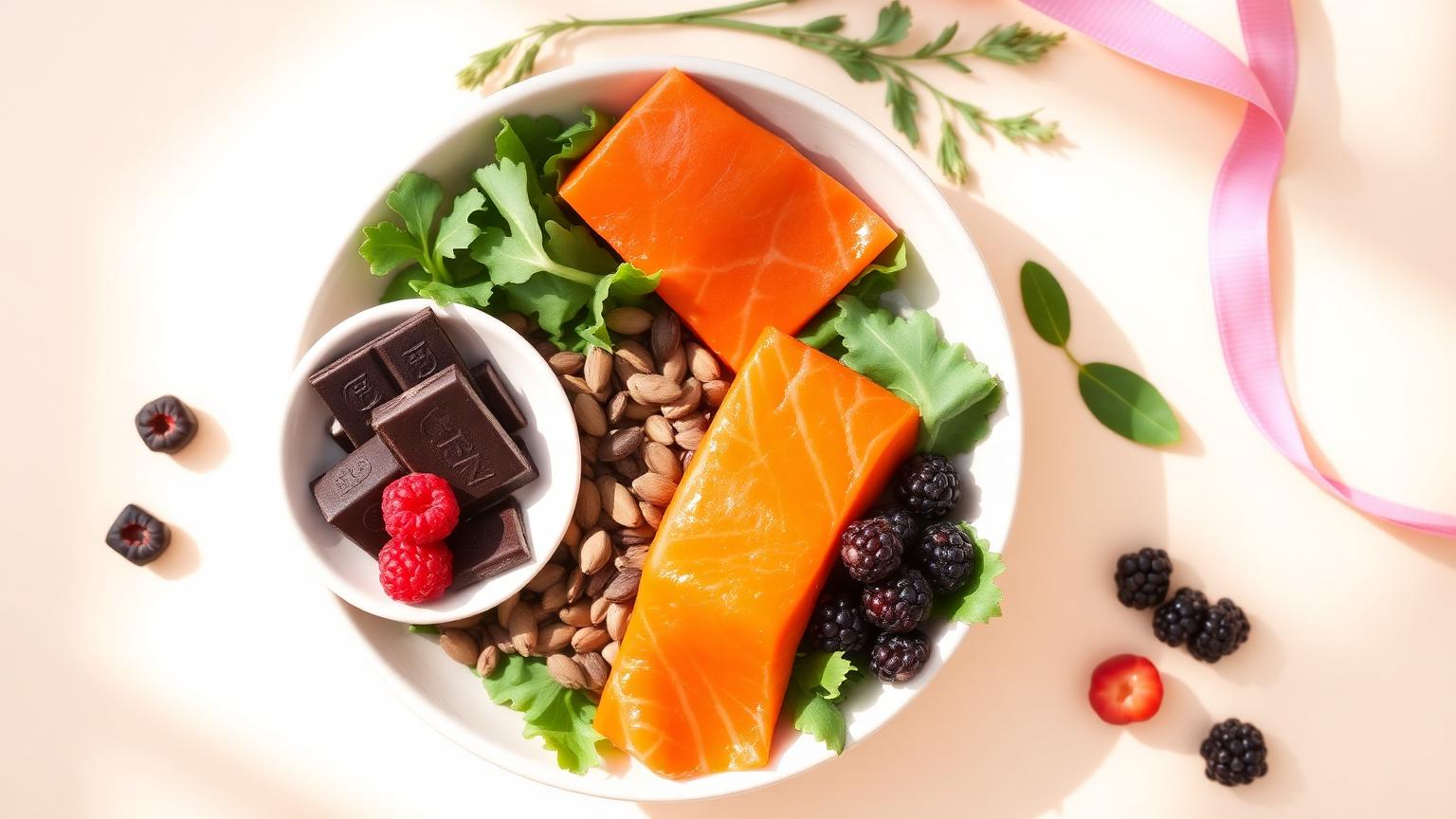
- Have snacks that don't betray you — pair the carbs with a little protein or fat instead of riding a lone handful of candy into the void.
Steadier blood sugar means fewer of those out-of-nowhere emotional cliffs. It won't fix the hormonal dip, but it stops you from stacking a sugar crash on top of it.
4. Look at magnesium and B6
These two get talked about a lot in the PMS conversation for a reason — they're nutrients tied to the systems doing all this behind-the-scenes work. Some women find that supporting their intake of magnesium and vitamin B6 helps them feel more even through the luteal stretch. As always, this is about support, not a cure, and it's worth a quick word with your doctor or pharmacist if you're pregnant, on medication, or managing a health condition before adding anything new. And if irritability and anxiety are your main mood signals, here's a fuller toolkit for managing PMS irritability and anxiety naturally.
5. Give your body consistent daily support
Here's the mindset shift: the week before your period isn't a great time to start taking care of yourself from scratch — it's a great time to be already supported. This is exactly the lane Full Balance was built for.
Full Balance is Feme's daily foundation — hormone-free daily capsules designed for everyday balance, mood, and energy all cycle long, not just during the four days you're actively plotting revenge on the world. The idea is consistency: instead of scrambling for backup when you're already in the trenches, you give your body steady, foundational support the whole month, so the rough week has a little more of a floor under it. Many women find that a daily foundation is the thing that makes the on-the-fly moments feel less chaotic.
And on the days that still catch you off guard — the cramps, the bloat, the skin breakouts, the emotional ambush — that's what the rest of the Feme lineup is for. But the mood conversation starts with the foundation.
How to actually be kinder to yourself that week
Strategy is great. But the part that changes your life is how you talk to yourself during the dip. So, some permission slips, signed by us:
- You're allowed to lower the bar. Not every week has to be a productivity montage. Do the essentials, punt the optional stuff, and don't hand yourself a guilt trip for it.
- You're allowed to warn people. "Hey, I'm in my pre-period week and running a little raw" is a full sentence and a gift to everyone around you. It's not an excuse — it's a weather forecast.
- You're allowed to not trust every thought. If a feeling shows up loud, sudden, and catastrophic during your luteal week, you're allowed to go "noted, might be hormones, I'll revisit this after my period." Sometimes the thoughts genuinely look different in a few days.
- You're allowed to take up space. Common does not mean acceptable, and "just deal with it" was always a bad deal. Wanting to feel good in your own body one week out of four is the least dramatic request in the world.
The goal here was never to fix you, because you are not broken. The goal is to understand the pattern, support your body through it, and stop spending energy apologizing for a monthly hormone shift you did not vote for.
Not sure where to start?
If you're reading this going "great, but which of these is actually my situation" — that's a fair question, and guessing is no fun. You can take the 3-minute quiz and get a Feme recommendation matched to what's actually getting in your way, whether that's mood, cravings, energy, or the whole messy ensemble. Start with the need, not the phase.
FAQ
Are PMS mood swings real or am I imagining it?
Very real. The emotional shifts that show up before your period are tied to natural changes in estrogen and progesterone, and how those interact with brain chemistry like serotonin. If you track your cycle, you'll usually see the mood dip land in the same window each month and lift once your period starts — which is exactly why it's a pattern, not you imagining things or "being dramatic."
How do I know if it's PMS or PMDD?
The general difference is intensity and impact: PMS mood swings are unpleasant but manageable, while PMDD involves severe premenstrual symptoms — like significant depression, anxiety, or anger — that genuinely disrupt your life and then ease after your period begins. We can't diagnose you, and this article can't either. If your symptoms feel severe or are interfering with your relationships, work, or wellbeing, please talk to a doctor. That's the right move, not an overreaction.
Can supplements help with PMS mood swings?
Supplements aren't medicine and aren't a cure, but many women find that supporting the basics helps them feel more even through the luteal phase. That includes nutrients often discussed in the PMS conversation, like magnesium and vitamin B6, alongside consistent daily support such as Full Balance, which is designed for everyday balance, mood, and energy. Think of it as building a steadier foundation, not flipping a switch.
What's the fastest thing I can change this month?
Blood sugar. Because a blood-sugar crash feels emotionally identical to a bad mood, simply not skipping meals and anchoring them with protein and fiber during your pre-period week can take the edge off those out-of-nowhere emotional dips. Pair that with protecting your sleep, and you've handled the two highest-leverage levers you actually control.
Feel good before, during, and after your period. Period.
You don't have to organize your whole life around one rough week a month. If mood, energy, and everyday balance are the thing getting in your way, Full Balance is the daily foundation designed to support you all cycle long — hormone-free, made by women, for women. Or if you'd rather get matched to your specific situation, take the 3-minute quiz and start with the need, not the phase.
Less "just deal with it." More you, feeling like you — all month.
These statements have not been evaluated by a regulatory authority. Feme products are supplements, not medicine, and are not intended to diagnose, treat, cure, or prevent any disease.